
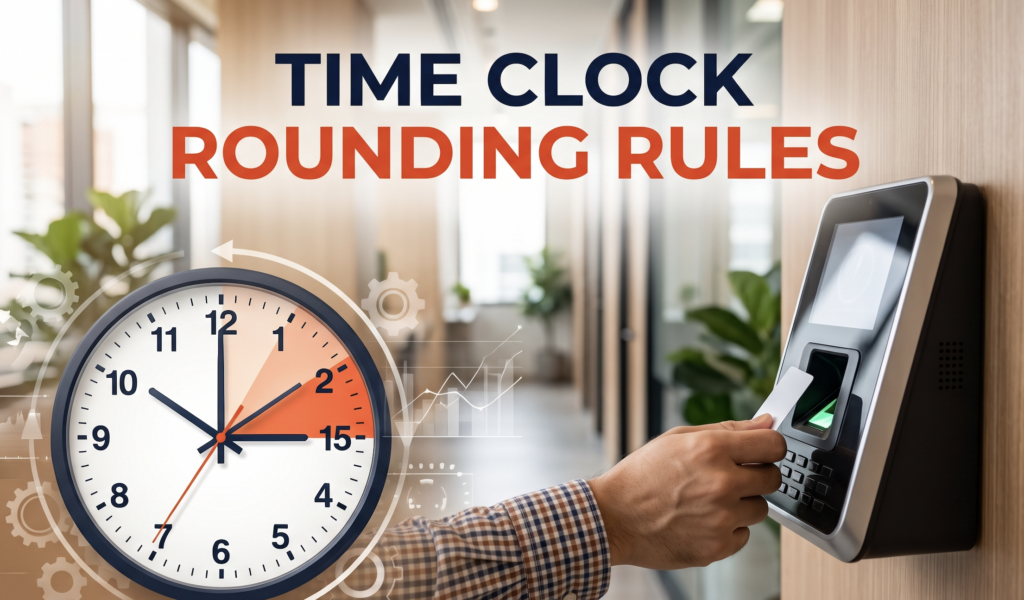


Time clock rounding rules may seem like a small payroll issue. Yet a few lost minutes can grow into unpaid wage claims. New guidance and recent court cases have made old rounding methods harder to defend. This guide explains the federal rule, state concerns, real payroll costs, and a safer way to track work time.
Many employers began rounding when paper cards and manual math made exact pay hard. Now, digital clocks can record each punch to the minute. Recent court decisions have questioned rounding when an employer can record and pay for the exact time worked. For that reason, business owners should review their policies before year end.
What Are the FLSA Time Clock Rounding Rules for 2026?
Federal time clock rounding rules appear in Section 785.48 of the Fair Labor Standards Act (FLSA) regulations. The rule lets an employer round punch to the nearest five minutes, six minutes, or quarter hour. Yet the method must work both ways. Over time, it cannot keep pay from workers.
For example, a quarter hour system can round a punch at 8:07 back to 8:00. A punch at 8:08 would round ahead to 8:15. The same method must apply when rounding adds paid time. An employer cannot round down when it saves money, then use exact time when that saves money.
The federal rule does not give an employer seven free minutes of work. It only permits a neutral way to total work time. In fact, the practice must average out so workers receive pay for all time worked. If the system keeps cutting paid minutes, it does not meet the federal test.
How Does the 7-Minute Rule Work?
The 7-minute rule applies when a company rounds to the nearest quarter hour. Each hour has four pay points: the top of the hour, 15 minutes, 30 minutes, and 45 minutes. A punch within seven minutes of one-point rounds to that point. A punch eight minutes past that point rounds to the next one.
Here is how a quarter hour system treats common punches:
- 8:00 through 8:07 rounds to 8:00
- 8:08 through 8:14 rounds to 8:15
- 8:15 through 8:22 rounds to 8:15
- 8:23 through 8:29 rounds to 8:30
- 8:30 through 8:37 rounds to 8:30
- 8:38 through 8:44 rounds to 8:45
- 8:45 through 8:52 rounds to 8:45
- 8:53 through 8:59 rounds to 9:00
These time clock rounding rules must apply to all punches in the same fair way. That includes early arrivals, late arrivals, early departures, and late departures. A policy may look fair on paper but still favor the company in use. For that reason, owners must test the real results.
When Do Time Clock Rounding Rules Become Risky?
Rounding becomes risky when workers lose more time than they gain. For instance, a company may let staff clock in seven minutes early but round each punch forward. At the end of a shift, the same company may require staff to finish all closing tasks before leaving. That setup can remove paid time each day.
Attendance rules can create another issue. An employer may discipline workers for arriving one minute late yet round away minutes worked before the shift. In this case, the policy treats the same minutes in two different ways. The employer keeps the benefit from both sides.
Managers can create more risk when they edit punches without a clear reason. For example, a manager may change an 8:08 punch to 8:00 for a favored worker. Next, the manager may leave another worker’s punch at 8:15. These changes make the policy hard to defend and can lead to unequal pay claims.
What Did Opinion Letter FLSA2026 8 Change?
On May 28, 2026, the Wage and Hour Division issued Opinion Letter FLSA2026 8. The request involved hospital staff who could clock in up to seven minutes early. The hospital then rounded those punches forward to the planned shift time. Some workers claimed they performed job tasks during the lost minutes.
The letter explains that an early punch alone does not prove paid work took place. An employee may clock in and then use the time for a personal task. Yet if the worker starts a required job task, that time may count as paid work. Examples may include reading charts, preparing tools, receiving reports, or finding an assignment.
Next, the agency explained that rounding cannot remove paid work in a way that favors the employer over time. The facts still matter, and one opinion letter does not settle every workplace case. Still, the letter gives owners a strong reason to check what staff do right after each punch. A digital timekeeping system like ezClocker, can limit early clock ins. Also, your employee handbook should state that employees may not clock in or begin work early without manager approval. Still, if an employee performs work before the shift and the employer knows about it, that time must be recorded and paid.
Need an Employee Time Tracking App?
How Much Can Lost Minutes Cost Per Employee?
Small cuts in time can create a large unpaid wage amount. Suppose an employee loses six paid minutes each day. The worker earns $18 per hour and works five days each week. Over 52 weeks, the employee loses 1,560 minutes, or 26 hours.
At the regular rate, 26 hours times $18 equals $468 in lost wages for one employee. For ten employees, the base wage loss reaches $4,680. The amount may rise if some time should have received overtime pay. Added damages, fees, and state penalties can raise the final cost again.
Now, consider a smaller loss of three minutes each day. That still equals 13 hours per year. At $18 per hour, the lost pay is $234 for one worker. These examples show why time clock rounding rules need more than a quick policy review.
How Rounding Can Affect Overtime Pay
Rounding can change more than regular wages. It can hide work that should push an employee past 40 hours. For example, an employee records 40 exact hours plus 20 minutes. If rounding removes those 20 minutes, payroll may show only 40 hours.
At an $18 base rate, the overtime rate is $27 per hour. Twenty lost minutes per week equals about 17.3 hours per year. At the overtime rate, that missing time equals about $468 for one employee. Once again, added damages or state penalties may increase the claim.
The risk grows when early setup or late cleanup happens every day. In many cases, this work follows a set pattern. That pattern can help a worker show that the company knew the work took place. Exact punches make those minutes easier to find and pay.
What States Have Time Clock Rounding Rules?
Federal time clock rounding rules create the starting point for most states. Yet state laws, wage orders, and court rulings can set a stricter standard. There is no simple federal list of states that approve rounding. Owners must review the law where each employee works.
California permits no rounding of meal period punches. The state’s high court ruled that meal records must show the full 30-minute period. California courts have questioned shift rounding when a digital clock already records exact minutes. Since this area remains complex, California employers should seek legal advice before using any rounding method.
Oregon takes a stricter view. The Oregon Bureau of Labor and Industries states that workers must receive pay for all hours worked. It also notes that the federal rounding approach is more lenient than Oregon law. As a practical step, Oregon employers should pay from exact punches.
Other states may follow federal rounding rules if the method stays neutral. Still, local rules for meals, rest periods, daily overtime, and wage records may change the result. Owners with workers in several states should check each work location. A wage and hour attorney can review rules that apply to the company.
Why Exact Minute Punches Remove Rounding Risk
Exact minute pay removes the need to prove that rounding averages out. The employer pays for the time shown on the record. At the same time, workers can see how payroll reached each total. This makes questions easier to resolve before payday.
Digital records can show when a shift started, when it ended, and who changed a punch. A manager can still fix a missed punch or clear error. Yet each change should include a reason and keep the first record. In turn, that history helps explain the final payroll total.
Exact pay does not mean staff can work whenever they choose. An employer can still set schedules and enforce attendance rules. It can also tell staff not to begin work before the shift without approval. Still, if the employer knows work took place, it must record and pay that time.
What Small Businesses Learned from Digital Time Tracking
Suzana Sukunda owns Homecare Your Way, a home care company with staff working in client homes. Paper timecards made it hard to check hours from many sites. After her team began using ezClocker, workers could record time from their phones. Suzana cut about one full day of office work from her week and gained clearer time records.
April Mills manages MDX Imaging Center in Guam. Her team used paper forms and an old fingerprint clock that did not work well. Staff sometimes wrote down hours when the clock failed. After the company moved to ezClocker, April could review punches and time reports without printing stacks of paper.
These cases do not deal with a wage claim. Instead, they show how exact digital records replace manual estimates and unclear entries. Better records give owners a sound base for payroll review. They also make it easier to stop rounding before it becomes a larger concern.
How to Audit Your Time Clock Rounding Rules
To begin with, pull at least three months of exact punches and rounded pay records. Compare the two totals for each worker. Do not review only the full group. A policy may favor the staff but still cut time from the same employee each week.
Next, review your written policy and your clock settings. Check the rounding span, meal settings, schedule rules, and manager edits. Then, look for times when work occurs before or after planned shifts. Ask supervisors about setup, cleanup, tool loading, job notes, and work messages.
After that, calculate the dollar gap for each employee. Include regular pay and overtime pay where needed. If the review finds unpaid work, speak with legal and payroll advisers about correcting it. Keep clear notes on the review and each change made.
This FLSA compliance guide offers a wider review of wage records, overtime, worker status, and paid work time. It can help owners connect rounding concerns with the rest of their payroll process.
A Safer Time Policy for 2026
A safer policy starts with exact minute tracking. Tell employees to clock in when work starts and clock out when all work ends. Also, tell them to report missed punches and any work done outside the planned shift. Managers should never ask staff to finish a task after clocking out.
From there, train each supervisor on paid work time. They should know that short setup tasks can count. They should also know that a rule against early work does not erase the duty to pay for work already done. Attendance issues and wage payments must be handled as two separate matters.
Finally, review punch changes before each payroll run. Look for repeated edits at the same time of day. Then, compare planned shifts with actual punches. This routine can find bad habits before they grow into wage claims.
Fix Risky Rounding Before Year End
Time clock rounding rules still exist under federal law in 2026. Yet a legal policy must stay neutral in both design and real use. State rules may require more, and recent cases show less patience for rounding when exact records exist. Paying by the minute is often the clearest way to reduce that risk.
Use a rounding compliance quick check to review your policy, punch data, manager edits, and state rules. If you need clearer records, you can test an employee time tracking app with a small part of your team. A free trial can help you compare exact digital punches with your current process before year end.
This article gives general business information and is not legal advice. Wage laws and court rulings vary by state and can change. Ask a wage and hour attorney to review the rules that apply where your employees work.