


The cost of employee turnover is one of the largest hidden expenses for small businesses. At first, replacing one worker may not seem serious. Yet over time, the cost of employee turnover grows fast and cuts into profit.
In many cases, owners focus only on hiring expenses. However, the cost of employee turnover includes lost time, lower output, and team stress. With that in mind, this guide explains what the cost of employee turnover really means. It also includes a simple employee turnover cost calculator you can use today.
Overall, when you understand the cost of employee turnover, you can fix the causes before they grow.
What Is the Cost of Employee Turnover?
To begin with, the cost of employee turnover is the total expense of losing and replacing a worker. In other words, it includes every dollar tied to exit, hiring, and training. For example, when an employee leaves, you may pay overtime to cover shifts. At the same time, managers spend hours posting jobs and reviewing resumes. In turn, training new hires takes weeks. According to the US Bureau of Labor Statistics (BLS), turnover remains common in many hourly industries. When that happens often, small businesses absorb repeated hiring costs.
More importantly, productivity drops during gaps. Customers may wait longer. Service may be slow. Over time, these hidden losses increase the cost of employee turnover beyond simple hiring fees. In short, turnover is not just a staffing issue. It is a profit issue.
Direct Costs of Employee Turnover
Now let’s break down direct costs. To begin with, direct costs are easy to measure. For instance, you may pay for job ads, background checks, or onboarding paperwork. Next, you may pay overtime to current staff. In many cases, overtime pay raises payroll totals quickly. When shifts go uncovered, overtime grows. You may also pay for uniforms, tools, or software access for new hires. At the same time, managers spend paid hours interviewing.
From there, add training wages. A new employee often works at a lower speed during the early weeks. In turn, output drops. The takeaway here is clear. Direct costs alone can reach thousands per employee.
Indirect Costs That Hurt Small Businesses
Indirect costs are harder to see. Yet in many cases, they hurt more. For example, when a strong worker leaves, morale may drop. In the same way, remaining staff may feel stress from added shifts. Over time, high turnover creates a cycle. Workers see others leave and question stability. In turn, retention weakens further. When that pattern repeats, growth slows.
At the same time, customer experience may decline. Regular customers notice new faces. If service quality dips, loyalty may fall. In this case, the cost of employee turnover spreads beyond payroll. It touches revenue and brand trust.
Need an Employee Time Tracking App?
What Is the Standard Turnover Formula?
Here is the standard formula:
Turnover Rate =
Number of Employees Who Left During the Period
Divided by
Average Number of Employees During the Period
Then multiply by 100
In equation form:
Turnover Rate =
(Employees Who Left ÷ Average Number of Employees) × 100
Now here is how to calculate the average number of employees:
Average Number of Employees =
(Number of Employees at Start of Period + Number at End of Period) ÷ 2
Example of Turnover Rate Calculation
- For example, imagine you had 25 employees at the start of the year.
- At the end of the year, you had 23 employees.
- First, calculate the average workforce:
- (25 + 23) ÷ 2 = 24 average employees
- Now, assume 6 employees left during the year.
Turnover Rate =
(6 ÷ 24) × 100 = 25 percent turnover rate
In this case, your annual turnover rate is 25 percent.
What Is an Employee Turnover Cost Calculator?
Now let’s define the tool.
An employee turnover cost calculator helps you estimate the total turnover expense per employee. In other words, it adds direct and indirect costs into one number.
- To begin with, list your average hiring expenses. Include job ads, recruiter time, and background checks.
- Next, calculate training wages and supervisor time. For example, estimate hours spent coaching during the first month.
- Then, add overtime paid to cover open shifts. In many cases, this is one of the highest hidden costs.
- From there, estimate lost productivity. You might compare the average output of a trained worker versus a new hire.
- Finally, multiply the total cost per employee by the number of departures per year. That final number shows your annual cost of employee turnover.
At this point, many owners feel surprised. The yearly total often exceeds expectations.
To make this simple, use this example. Here is a sample employee turnover cost calculator.
- Job posting and ads: 300 dollars
- Manager interview time: 500 dollars
- Training wages: 1,200 dollars
- Overtime coverage: 800 dollars
- Lost productivity estimate: 1,000 dollars
- Total per employee: 3,800 dollars
Now imagine five employees leave each year. 3,800 times 5 equals 19,000 dollars annually. In this case, the cost of employee turnover equals nearly 20,000 dollars per year.
When that happens, prevention becomes a smart investment.
Example of Estimating Lost Productivity
For example, imagine a trained employee completes 20 service calls per week. That worker knows the systems, tools, and customers well. Now compare that to a new hire. In the first four weeks, the new employee may complete only 12 service calls per week.
That means you lose 8 service calls weekly during training. If each service call brings in 150 dollars, the math becomes clear. 8 fewer calls times 150 dollars equals 1,200 dollars in lost revenue per week. If training lasts four weeks, that equals 4,800 dollars in lost productivity for just one new hire. In this case, lost productivity alone may exceed your job posting or training wage costs.
You can adjust this formula for your own business. Compare the average weekly output of a trained employee to a new hire. Then multiply the gap by your average revenue per task. From there, multiply that number by the number of training weeks. When you calculate it this way, the cost of employee turnover becomes much easier to see.
Why Small Businesses Face High Turnover
In many cases, small businesses struggle with turnover more than large firms. That is often tied to hourly roles. For example, inconsistent schedules frustrate workers. When hours change weekly, income becomes unstable. In turn, employees look elsewhere.
At the same time, unclear time tracking creates paycheck disputes. If workers question pay accuracy, trust drops.
According to the Society of Human Resource Management (SHRM), the cost of replacing an employee can range from 50% to 200% of their annual salary, depending on their level. When that repeats, small firms feel pressure quickly. The takeaway here is simple. Turnover often links to daily systems, not just wages.
How Scheduling and Time Tracking Affect Retention
Now let’s connect systems to turnover. To begin with, fair scheduling builds stability. Employees who know their hours ahead of time can plan life outside work.
In the same way, accurate time tracking builds trust. Workers want to see clear records of their hours. Employers also need accurate records they can trust. An automated system reduces time theft and payroll disputes. When trust happens, disputes fall. In turn, morale improves.
MDX Imaging Center previously used paper timesheets. Once they started using ezClocker’s GPS verification, they could see exactly when and where employees clocked in. In the past, some employees would clock in on their way to the office, before they’d sat down to begin work. Though the time increments were small, it was still costly. Over time, when employees trust payroll accuracy, satisfaction rises.
Julie Kuhlmann, from Polished to Perfection, found out from a client that some of her employees were rarely on site for the number of hours indicated on their timesheets. So, she looked for a time-keeping app with a GPS function that pinned a location each time an employee clocked in or out. She came across ezClocker and put it to the test.
After a few pay periods, she discovered discrepancies and dealt with the problem. Lack of trust is not a business risk Julie is willing to take.
In short, tools that track time and manage schedules can reduce the cost of employee turnover.
Practical Steps to Reduce the Cost of Employee Turnover
Now that you see the numbers, let’s focus on action.
- First, review your scheduling practices. Provide the correct hours when possible. In many cases, stability matters as much as pay.
- Next, improve onboarding. Clear training plans help new hires feel confident sooner.
- Then, review time tracking systems. If employees question pay accuracy, address it quickly.
At the same time, create open feedback channels. Ask workers what causes stress. From there, track turnover monthly. Calculate the cost of employee turnover each quarter. When you measure it, you can manage it.
Over time, consistent systems reduce chaos. In turn, retention improves.
The True Annual Impact of the Cost of Employee Turnover
Now let’s look at the yearly impact in more depth. In many cases, owners calculate the cost of employee turnover per worker but stop there. Yet annual turnover continues year after year, increasing total cost. For example, imagine a small construction company with 20 hourly employees. If six employees leave each year and each departure costs 4,000 dollars, that equals 24,000 dollars annually. At the same time, add the manager’s hours spent hiring. Add slower service during training. Add lower team morale.
In turn, the true cost of employee turnover may exceed your initial estimate. Over time, that yearly loss may equal the salary of a full-time manager. That realization changes how you view retention.
How Turnover Affects Team Performance
Now consider the human side. When turnover rises, team culture shifts. In many cases, strong workers feel frustrated when new hires rotate often. For example, experienced staff may train new hires repeatedly. In turn, they lose focus on their own tasks. At the same time, customer service may suffer. Regular clients value familiar faces. When staff changes often, customer trust weakens. Stable teams support business growth. When that stability breaks, growth slows. Also, high turnover signals internal stress. Employees rarely leave stable, fair environments without reason.
At this point, the cost of employee turnover becomes a warning sign, not just an expense line.
How Poor Scheduling Increases the Cost of Employee Turnover
In many small businesses, schedules change weekly, and shifts swap at the last minute. When that happens, income becomes unpredictable. Workers struggle to plan child care, school, or second jobs. In turn, frustration builds. For example, a worker who expected 35 hours may receive 20. In this case, income drops suddenly. Over time, employees leave for steadier roles. In the same way, excessive overtime burns out staff. Overtime rules protect employees, yet repeated long hours increase fatigue. When workers feel overworked one week and under scheduled the next, satisfaction falls.
The takeaway here is clear. Predictable scheduling reduces the cost of employee turnover.
Using Time Tracking as a Retention Tool
Now let’s shift perspective. Most businesses see time tracking as a payroll tool. Yet often, it is also a retention tool. To begin with, digital clock in systems create visible records. Employees see their own hours daily. In the same way, managers can correct errors quickly. When that happens, disputes shrink. For instance, ezClocker provides mobile clock in features that allow managers to review hours in real time. That reduces end of pay period surprises. You can review features at https://ezclocker.com At the same time, reporting tools help managers spot patterns. For example, if one worker logs constant overtime, you can adjust schedules before burnout grows. In turn, staff feel supported rather than stretched.
Over time, fair time tracking systems reduce friction and lower the cost of employee turnover.
Building a Simple Retention Plan for Small Businesses
Now let’s turn this into action.
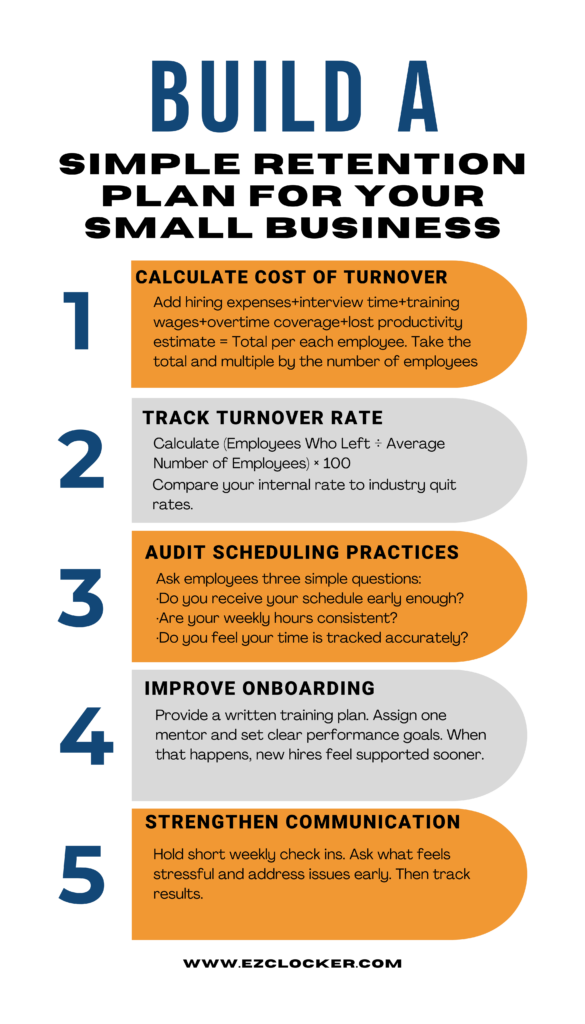
Step one: Calculate your current cost of employee turnover using the earlier calculator method.
Step two: Track turnover rate monthly.
According to the BLS, you can compare your internal rate to industry quit rates. When your rate exceeds industry averages, a deeper review helps.
Step three: Audit scheduling practices.
Ask employees three simple questions.
- Do you receive your schedule early enough?
- Are your weekly hours consistent?
- Do you feel your time is tracked accurately?
Often, these answers reveal more than exit interviews.
Step four: Improve onboarding.
For example, provide a written training plan. Assign one mentor. Set clear performance goals. When that happens, new hires feel supported sooner.
Step five: Strengthen daily communication.
Hold short weekly check ins. Ask what feels stressful and address issues early. In turn, small problems stay small.
How to Measure Improvement Over Time
Now that you have a plan, track results.
- First, measure the monthly turnover rate.
- Next, calculate total hiring costs each quarter.
- Then, track the average overtime hours.
When overtime drops and turnover slows, progress becomes visible. Over time, your cost of employee turnover should decline. For small teams, even a 10 percent reduction saves thousands annually. For example, if your yearly turnover cost equals 30,000 dollars, a 10 percent reduction saves 3,000 dollars.In turn, those savings may fund raises, bonuses, or better training.
The Bigger Picture for Small Business Owners
On the whole, the cost of employee turnover affects profit, culture, and long term growth. Many owners focus only on wages, yet leadership and communication shape retention just as much.
Clear expectations, fair treatment, and consistent management build loyalty. When employees feel respected and supported, they are far more likely to stay.
Final Thoughts
The cost of employee turnover goes far beyond hiring expenses. It creates ongoing financial risk for small businesses. In growing businesses, hidden causes such as poor scheduling or payroll confusion increase that cost. When you calculate the numbers and fix root issues, retention improves. At the end, small system upgrades can produce large savings. If you review your turnover numbers this quarter and make one practical change, you move closer to stable growth and lower long term labor costs.